Proposal Preparation and Submission
About Proposal Preparation and Submission
We offer pre-award support with compiling proposal components, developing budgets, ensuring compliance with sponsor agency requirements and routing proposals for approval.
All proposals to externally funded programs (federal, state, local, foundation, corporation) must be routed through ORSP for SFSU approval, as required by the California State University’s Sponsored Programs Administration Policy.
Eligibility to Apply for External Funding
A principal investigator (PI) holds overall responsibility for the design, conduct, reporting and integrity of a project. The right to serve as PI at SFSU, per the Principal Investigator Status Policy and Procedure, is automatically granted to the following people:
- Tenured and tenure-track faculty
- Incoming tenured or tenure-track faculty with a signed acceptance letter and a volunteer appointment in a college
- Emeritus faculty with a volunteer appointment in a college
- Management Personnel Plan (MPP) employees
Proposal Submission
The first step in working with us to apply for external funding is to submit a principal investigator (PI) checklist (see instructions). You will then be assigned a grant administrator who will help with proposal preparation and routing for SFSU approvals. If you have a question and do not have an assigned grant administrator, email orsp@sfsu.edu.
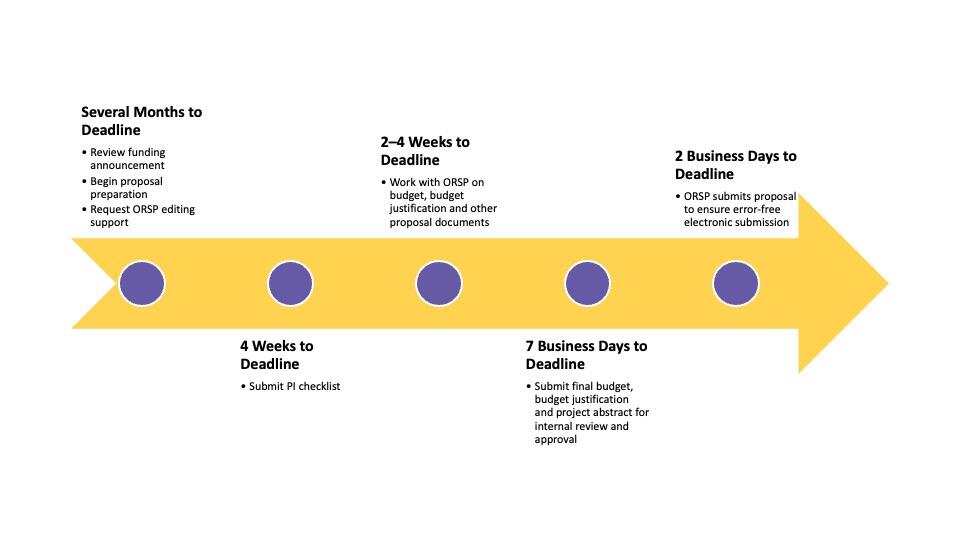
Several months before an agency deadline, you should review the funding announcement, begin proposal preparation and request ORSP editing support. PI checklists should be submitted at least four weeks before an agency deadline. Those submitted under four weeks will be assessed, but with short notice we cannot guarantee that a proposal will be approved for submission. After submission of the Pl checklist, ORSP will work with you on the budget, budget justification and other proposal documents.
The following must be finalized at least seven business days before the agency’s deadline to initiate the approval process:
- Budget
- Budget justification
- Project abstract, summary or scope of work
- Financial conflict of interest disclosure
Two business days before the agency's deadline, ORSP will submit the proposal to ensure error-free electronic submission.
Budget Development
Most proposals require a budget and budget justification. The budget outlines project costs and should align with the activities described in the project narrative. The budget justification explains the necessity for each line item in the budget and details methods of calculation. Your assigned grant administrator will work with you to set up a budget.
Direct and Indirect Costs
As a recipient of federal funds, SFSU is required to adopt costing policies that conform to federal rules and regulations in the Uniform Guidance (2 CFR § 200). Per this guidance, the total cost of a project is the sum of the allowable direct costs related to its performance — salaries, project-specific equipment and supplies, travel and other activities — plus the allocable portion of the indirect, or facilities and administrative (FA), costs.
Indirect, or F&A, costs are those incurred for general institutional operations benefitting a project but which cannot be easily assigned to a particular project, such as the following:
- Salaries, wages and fringe benefits for essential administrative staff
- Utilities
- Books and periodicals
- Memberships and subscriptions
- Office supplies
- Office and general equipment (e.g., office furniture)
- Repair and maintenance (e.g., equipment)
- Telephone and internet (e.g., monthly bills)
- Photocopying
- Postage
- Proposal development costs
Common Budget Categories
Salaries and wages: Salaries and wages for all project personnel, including student assistants, should be included. For each person, indicate the time to be spent on the project and the amount to be paid by the sponsor. Where appropriate, indicate the base salary and the method used to arrive at the requested amount. Include estimates of salary increases. Faculty academic year and intersession salary is based on actual salary.
Fringe benefits: Fringe benefits are calculated as a percentage of salaries and wages and include all benefits such as retirement, social security, and health and life insurance. Ask your assigned grant administrator for current rates.
Equipment: Major equipment purchased under a grant must be necessary and allowable and its use explained. Work with your assigned grant administrator on such purchases.
Travel: Domestic and foreign travel should be listed separately. Detail estimated costs such as meeting registration fees, transportation and meals and lodging. Unless further restricted by sponsor regulations, all travel is subject to SFSU policy.
Materials and supplies: Materials and supplies include consumable items (e.g., chemicals, laboratory breakables) required for a project.
Publication costs: Publication costs include handouts, journal charges, cost of illustrations and costs of preparing and producing reports required by the sponsor.
Other categories: Other budget categories include participant support costs, consultant and contractual services and subcontracts to collaborating entities. Consult your assigned grant administrator for guidance.
Indirect (F&A) costs: The indirect, or F&A, cost rate used by SFSU is negotiated periodically with the Department of Health and Human Services in accordance with federal regulations. Consult your assigned grant administrator for guidance on indirect costs.