Planetarium and Observatory
Come See The Stars!
The Charles F. Hager planetarium and SFSU Observatory — both beloved campus hallmarks for decades — are open to students in the department and to the public. The planetarium regularly offers lunchtime shows, shows for the public, for schools and more. Observatory docents invite visitors to view the sky via our rooftop telescopes. Check with both the planetarium and observatory to plan a visit.
Charles F. Hagar Planetarium
The Charles F. Hagar planetarium opened its doors in 1973. Since that time, we have served an estimated 100,000 visitors, including SFSU students, San Francisco school children, community groups, and members of the general public. Noche de Estrellas is a bilingual (Spanish and English) event for the SFSU community and the public that combines science talks, planetarium shows and roof-top observatory viewings. We have also trained and mentored hundreds of undergraduate and graduate students interested in planetarium operations and science education and outreach. Many have gone on to careers in education in the Bay Area, California, and beyond. All of our offerings are free and the planetarium is wheelchair accessible.
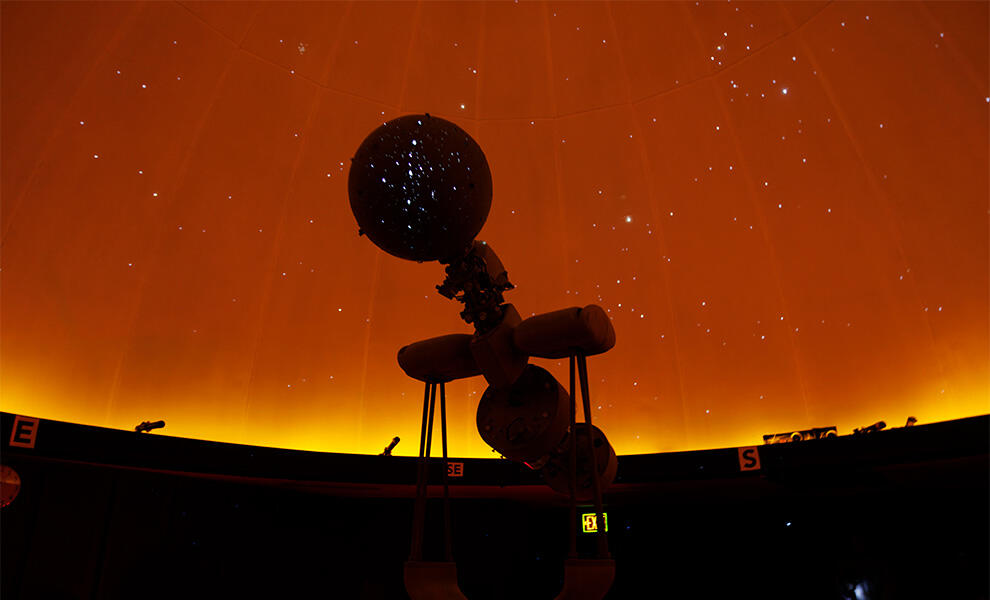
The planetarium dome is 26.5 ft (8.1 meters) in diameter, takes up two floors in Thornton Hall, and seats 45 visitors in three concentric circles. The planetarium houses a Spitz Space systems 512 projector that displays 1,354 stars on the dome, along with the Sun, Moon, and planets. The Spitz, which was state-of-the-art at the time it was installed, also projects the celestial equator, the ecliptic, the meridian, and several constellation figures. We use the planetarium to give live shows in which we simulate what the sky looks like from anywhere on Earth, at any time of the day or night, rain or shine (or fog). We also use it to to speed backwards and forwards in time to help visualize and make sense of the patterns of motions of celestial bodies.
Charles F. Hagar was a professor in Department of Physics and Astronomy at SF State from 1959 to 1994, and continued to teach at SF State for ten years after his retirement. He designed all the astronomy-related facilities in Thornton Hall, including the planetarium and the observatory. The planetarium was named for Professor Hagar upon his retirement.
Where is the planetarium?
Thornton Hall, 4th Floor, Room 422
San Francisco State University
1600 Holloway Avenue
San Francisco, CA 94132
Free Lunchtime Shows
Fall 2026, visit Fridays noon – 12:45 p.m. for Exploring Tonight's Night Sky and Motions of Celestial Bodies, presented by staff member Jim Gibson. Last admittance is 5 minute after start time. Shows will continue in the Fall 2026 semester until we close for renovation.
SFSU Observatory
The SFSU Observatory is a student-run facility open to all students, staff and members of the public two or three nights per week in fall and spring semesters. With the aid of observatory docents, visitors use telescopes to look at craters on the Moon, the rings of Saturn, giant star clusters, nebulae created by dying stars, the Andromeda galaxy and much more. Need a study break? Drop by and bring a friend!
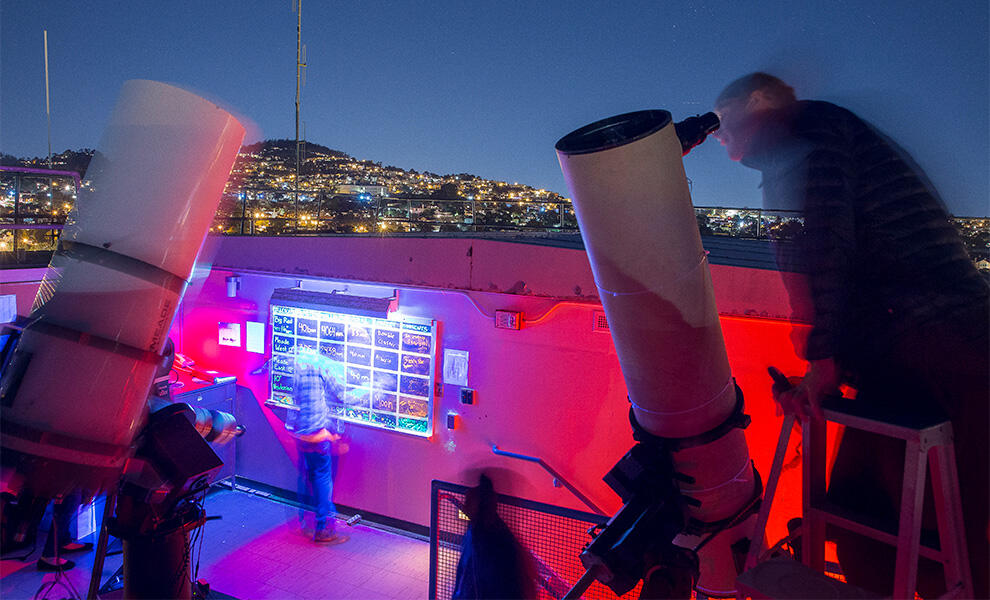
Where is the observatory?
- Take the elevator to the 9th floor of Thornton Hall.
- Find the stairwell close to the elevator.
- Walk to the top of the stairs.
- The door to the observatory will be on your LEFT.
When is the observatory open?
The Observatory is open ONLY when skies are clear. Please check our Instagram to confirm if we are closed due to poor weather conditions. For up-to-date information about whether the skies are clear and if the Observatory is open, check our Instagram. Please note that in case of high winds the observatory may close even if skies are clear.
Fall 2026 public open nights
Wednesday, Thursday and Friday nights, when skies are clear.
| September 16, 17, 18, 23, 24, 25, 30 | 7:30 – 9:30 p.m. |
| October 1, 2, 7, 8, 9, 14, 15, 16, 21, 22, 23, 28, 29 30 | 7:00 – 9:30 p.m. |
| November 4, 5, 6, 12, 13, 18, 19, 20 | 6:30 – 9:00 p.m. |
| December 2, 3, 4 | 6:30 – 9:00 p.m. |
The observatory will be CLOSED for Veterans day, Wednesday, Nov 11. The observatory will be CLOSED during Fall Recess, November 23–27, 2026. The Observatory will be CLOSED the last week of classes (Dec 7–11). The LAST open public night (weather permitting) will be Friday, Dec 4, 2026. |
What might I get to see if I visit the observatory in Fall 2026?
- Saturn and its large moon Titan!
- Venus in a crescent phase; September only
- Double star system Albireo in Cygnus (beautiful pair with contrasting colors); Sept/Oct
- Eta Cassiopeiae binary star system (twin of the Sun but with binary companion in a 472-year orbit!); Oct-Dec
- Andromeda galaxy (nearest spiral galaxy to the Milky Way; also known as M31); Oct-Dec
- A close-up view of the Moon and its many craters — whenever the Moon is up!
Classes
Interested in taking a class in the planetarium or observatory? Several options are available. Questions about classes or becoming a planetarium/observatory docent? Please contact the Planetarium and Observatory director.
ASTR 116: Astronomy Laboratory (GE)
Students in this course make use of the planetarium for many of their weekly laboratory activities. ASTR 116 fulfills the General Education laboratory science requirement. Typically ten sections of ASTR 116 are offered each semester, serving approximately 300 students. Students interested in this lab must take ASTR 115 or is equivalent as a prerequisite or co-requisite.
ASTR 301: Observational Astronomy Laboratory
Students majoring or minoring in astronomy, or with a particular interest in the subject, make use of the advanced capabilities of the planetarium in ASTR 301. They use it to study astronomical coordinate systems, make sense of the apparent motions of the sun, stars, and planets, and learn their way around the night sky in preparation for mastering the use of the telescopes in the SF State Observatory.
Planetarium Workshop
A training program for students interested in learning to operate the planetarium projector and create shows is offered as a weekly workshop. An introductory workshop is typically offered in the fall semester followed by an advanced workshop in the spring, depending on demand. The prerequisite for participating in the workshop is one semester of astronomy, typically ASTR 115 or ASTR 300. Students from all majors are welcome and encouraged. Students who successfully complete the workshop may receive one unit of ASTR 685 credit. Enrollment is limited; please contact the Planetarium & Observatory Staff for further information.
Elementary Education 655: Hands-on Undergraduate Science Education Experience ("STEM HOUSE")
Undergraduates who take the fall-semester offering of EED 655 study the space-science content in the elementary and middle school science curriculum using a variety of hands-on activities, including activities that take place in the planetarium. Students develop lesson plans and teach the material to groups of school children who come to the SF State campus on field trips. Open to all majors with upper-division standing; recommended for students considering a career in K-12 teaching.
Several SF State courses make use of the Observatory. ASTR 116 students use the telescopes to complete one or more observing assignments over the course of the semester. ASTR 115 instructors may also assign optional homework to be completed in the Observatory. Students in the junior-level ASTR 301 lab make extensive use of the Observatory as they develop their knowledge of the night sky, learn to operate the telescopes, and study telescope optics. Students in the advanced ASTR 470 & 770 carry out projects in the Observatory as they study astronomical photometric and spectroscopic techniques.
Students who complete ASTR 301 are eligible to become Observatory docents. Docents are eligible to earn a unit of credit by enrolling in ASTR 685. Students who are interested in becoming docents but have not yet completed ASTR 301 may apply to become apprentice docents.
Career training
Hundreds of undergraduate and graduate students interested in planetarium operations and science education and outreach have received training, experience, and mentoring in the SFSU Planetarium. Many have gone on to careers in informal or formal education in the Bay Area and beyond.
Aaron White
M.S. Physics/Astronomy, 2019
Planetarium presenter
California Academy of Sciences
San Francisco, CA
Miranda Waters
B.S. Astrophysics, 2017
Planetarium presenter
California Academy of Sciences
San Francisco, CA
Jacqueline Benitez
B.A. Astronomy, 2012
Education Specialist
California Academy of Sciences
San Francisco, CA
M. Joshua Roberts
B.A. Astronomy, 2012
Planetarium Manager
California Academy of Sciences
San Francisco, CA
Theresa Summer
B.A. Astronomy, 2007
Astronomy Educator
Astronomical Society of the Pacific
San Francisco, CA
Vivian White
B.A. Physics, 2006
Director, Free Choice Learning
Astronomical Society of the Pacific
San Francisco, CA
Jason Dorfman
B.S. Astrophysics, 2004
Planetarium Staff
Bays Mountain Planetarium
Kingsport, TN
Lynda Williams
M.S. Physics, 1996
Professor of Chemistry and Physics
Santa Rosa Junior College
Santa Rosa, CA
Keith Waxman
M.S. Physics, 1995
Professor of Astronomy
Santa Rosa Junior College
Santa Rosa, CA
Linda Shore
M.S. Physics, 1986
Chief Executive Officer
Astronomical Society of the Pacific
San Francisco, CA
Ron Hipschman
M.A. Physics, B.A. physics
Staff Scientist
Exploratorium
San Francisco, CA
Contact Us
Jim Gibson
- Astronomy Equipment Technician
Adrienne Cool, Ph.D.
- Professor
- Director of Charles F. Hagar Planetarium and SFSU Observatory
- Astronomy Graduate Coordinator