Five women who shaped SF State
University Archivist Meredith Eliassen commemorates Women’s History Month with a salute to remarkable female faculty members
- By Strategic Marketing and Communications
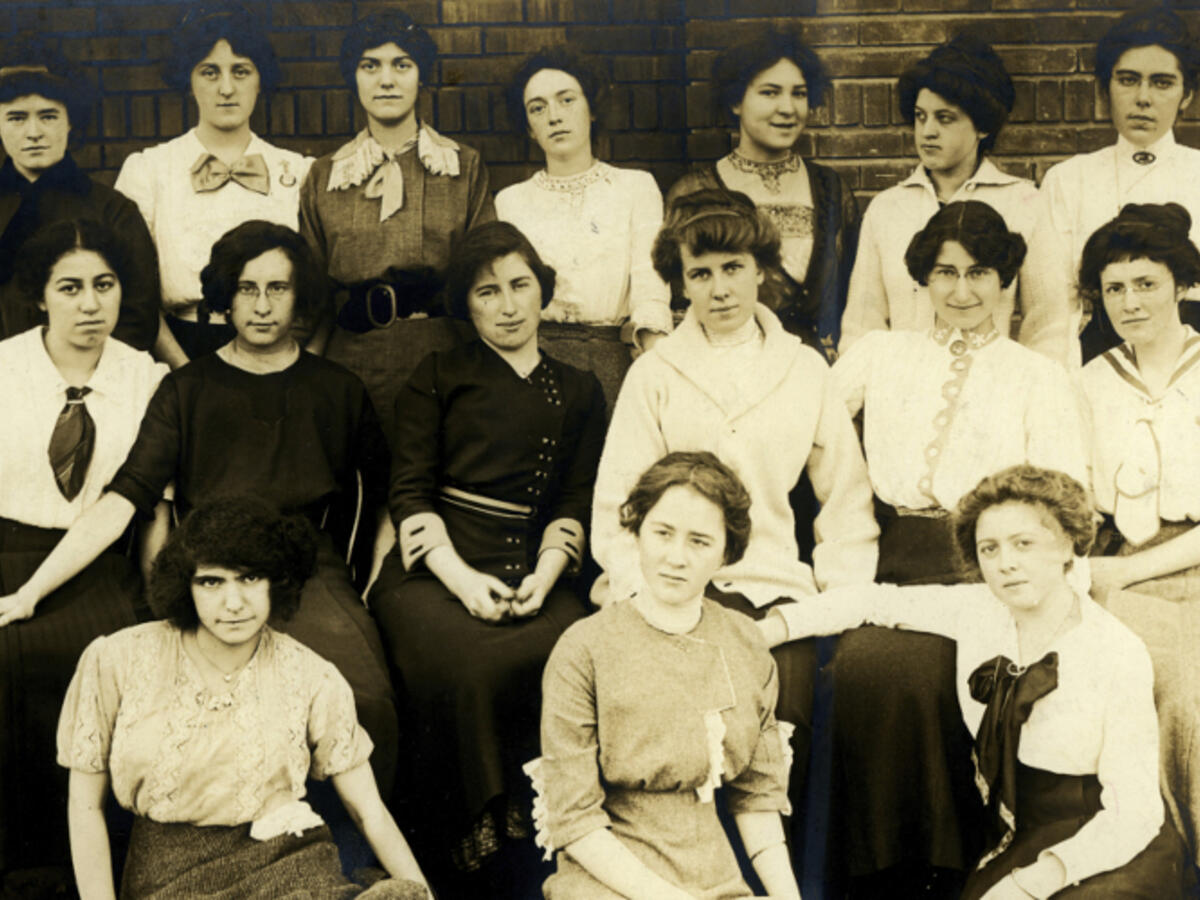
March is Women’s History Month — and there's plenty of women's history to celebrate at San Francisco State University. That’s why we turned to University Archivist Meredith Eliassen, who wrote about the lasting impact of pioneering staff member Mary Anna Ward for SF State Magazine’s Fall/Winter 2019 women’s issue. Below, Eliassen spotlights five more women who left their mark on San Francisco State ... and the world.
Dr. Edna Locke Barney
When SF State was founded in 1899 — with a student body that was 100 percent women — female physicians were a rarity. Yet when the University’s first president, Frederic Burk, hired a college physician in 1919, he chose a female doctor with a long and distinguished track record. Dr. Edna Locke Barney had made her mark as an instructor and leader at the Children’s Surgical Clinic at the California Medical School. She paved the way for quality health services for SF State students, guiding many through their darkest moments with her renowned honesty and wry humor. She also taught a number of courses over the years, pioneering health education at the University with a physiology class for future elementary school teachers. Thanks to her leadership, SF State became the first California state college to offer a degree program for nurses.
Olive Thompson Cowell
Stuck in Germany at the beginning of World War I, Olive Thompson witnessed firsthand the slaughter in the trenches. What she saw sparked a commitment to pacifism and world peace that stayed with her the rest of her life. Hired to oversee SF State’s social sciences instruction in 1919, she became one the first women in the United States to teach international relations. In 1933, she founded the International Relations Club to encourage student engagement in conversations on such topics as race and nationalism. Three years later she established the International Relations major to instill in students an understanding of world affairs and foreign service. International Relations became a department in 1950, and today it’s a thriving part of the College of Liberal & Creative Arts.
Hilda Taba
Before coming to SF State in 1951, soft-spoken curriculum reformer and educator Hilda Taba taught seminars for the United Nations Educational, Scientific and Cultural Organization (UNESCO) in Paris and Brazil where she researched teaching techniques, cognitive processes in children and relationships between ethnic groups. While at the University, she developed an approach to teaching that rang true during the civil rights era. Under the Taba approach, a teacher facilitates class discussion and encourages students to relate their ideas and opinions as peers, creating a safe, non-judgmental learning environment. The instructor’s role is to encourage peer-to-peer teaching, with students expanding on classmates’ ideas as they clarify their own. This revolutionary, open approach to teaching helped lay the groundwork for SF State’s Experimental College and College of Ethnic Studies and still influences educators today.
Bertha H. Monroe
Early in its history, SF State began welcoming immigrants with open arms — and open textbooks. Sociology Professor Bertha H. Monroe initiated a series of courses for an “Immigrant Education” program at SF State in 1923. As part of the University’s Department of Immigrant Education, students taught immigrant children and adults at a teacher training school called the People’s Place in North Beach, and SF State faculty developed a handbook for teaching English pronunciation to recent immigrants. The classes that Monroe introduced were eventually integrated into the Sociology curriculum, and Monroe continued to direct the North Beach training center until the early 1940s.
Ruth Witt-Diamant
English Professor Ruth Witt-Diamant wielded enormous power in the literary world that emerged in San Francisco in the first half of the 20th century. During the 1930s, the campus’s Poetry Club regularly met at her house on Mendoza Avenue for readings. Poets including Dylan Thomas, W.H. Auden and Madeline Gleason were among her personal friends and would read their work for her classes. In 1954, Witt-Diamant persuaded SF State President J. Paul Leonard to invite Auden to speak at the dedication ceremony for the University’s then-new Lake Merced campus (today’s main University campus). SF State paid Auden a $200 honorarium, half of which he donated to Witt-Diamant to fund her dream project: launching a Poetry Center at SF State. In the years that followed, the Poetry Center would record readings by such legendary literary figures as Theodore Roethke, Jack Spicer, Robert Duncan and Kenneth Rexroth. The Poetry Center Reading Series, founded in 1954, remains one of the longest-running such programs in the country, presenting dozens of performances each year.