EHS Annual Report for CY 2024
Executive Summary
CY 24 was a challenging year for the University in responding to lower enrollments and reduced funding. For EH&S, it was a similarly challenging time. We struggled to provide full service with a reduced staff while EH&S regulatory requirements increased, and new buildings were coming online.
Our OSHA case incidence rate remained below the CSU average.
Despite our staffing and budget challenges, inspections by external regulatory agencies did not result in any citations or penalties for the 7th year in a row.
TRAINING
Full compliance with EH&S regulatory training requirements remains a continuing challenge for the campus.
A cabinet level report on EHS training compliance was developed as a tool to improve management accountability.
A new hazard questionnaire-based system of identifying individual training requirements has been proposed. Implementing the new system locally would be made obsolete when HR converts to a systemwide HR MIS, so the concept has been proposed and accepted for a systemwide implementation.
Tracking of required EH&S training in laboratories is difficult because lab managers do not have CSU Learn access to the training records of the members of their lab. EH&S is working with Systemwide L&D and CSU-Learn on a solution.
INSPECTIONS
During the course of a year, EH&S performs, audits, accompanies inspectors performing, or manages contractors to conduct, more than 25,000 inspections. EH&S uses trained student aides to conduct many of the required internal safety and environmental regulatory inspections. Budget as well as EH&S Staff and student reductions have taken a toll on our ability to complete inspections on time.
PROGRAM MAINTENANCE & DEVELOPMENT
Program development continues on several fronts most notably in preparation of a Facilities employee and contractor safety handbook. The handbook contains rules for the safe performance of various kinds of work and describes a set of hazardous work permits to ensure proper precautions are in place before particularly hazardous work can take place. When work on the handbook was completed, in 2024. “Orientation to the Facilities Employee and Contractor Safety Handbook” training for employees will take place in 2025. Copies of the handbook will accompany requests for proposals so that compliance with the handbook will become a requirement of contractors working on SFSU premises.
To comply with a new regulatory requirement EH&S developed a Workplace Violence Prevention Program that defines program responsibilities for several campus departments including: UPD, Title IX, HR, Workers Compensation, Employee Relations, Risk Management, Counseling & Psychological Services, and EH&S. Ingrid Williams Sr. AVP of HR serves as the program administrator.
EH&S Staff
RESOURCES
The EH&S department currently has 5 staff members: a director, and 4 senior EH&S specialists.
Existing staff strives to “work smarter” by networking, professional development, and collaborating with other CSU EH&S departments.
The department is also supported by a small team of student aides that help maintain critical programs and regulatory inspection requirements.
PROFESSIONAL DEVELOPMENT
EH&S staff continues to pursue professional development to build skills and cross train, adding advanced degrees and professional certifications along the way, while empowering our staff to provide backup coverage for one another during times away from work for vacation or sick leave.
Personnel Org Chart EHS Staff Program Responsibilities List
Inspections
EH&S performs, audits, accompanies, or manages contractors to conduct, more than 25,000 inspections each year. Below are hyperlinks to descriptions of inspections with reports of inspection results for the past year.
Regulatory Agency Inspections
Aboveground Storage Tanks
Inspection Requirements
The San Francisco City and County CUPA’s AST program regulates aboveground storage tanks that are used to store petroleum products. The goal of the annual AST inspection program is to ensure that aboveground storage tanks are installed and maintained in a safe and responsible manner to prevent spills and releases.
CY 2024 Update
All internal inspections were completed.
CUPA inspected the ASTs program and concluded that there were no violations.
Air Compressors
Inspection Requirements
Cal/OSHA requires a permit if the air compressor tank is 1.5 cubic feet in volume or larger, OR when the safety valve is set greater than 150 pounds per square inch (psi). (Tanks with less than 1.5 cubic feet of air AND less than 150 psi ARE EXEMPT.)
Cal/OSHA requires air tanks requiring a permit to operate to be inspected internally and externally at least once every 3 years for portable tanks and once every 5 years for all other tanks.
CY 2024 Update
SFSU has 29 air tanks that require a permit to operate.
Air tank permits and inspections are up to date for CY 2024.
Air Permits – Boilers
The function of a boiler is to either produce hot water or steam. The Bay Area Air Quality Management District, (BAAQMD) inspects the campus for compliance with existing air permit conditions for boilers.
Inspection Requirement
The Bay Area Air Quality Management District, (BAAQMD) inspects the campus annually for air permit compliance and does source testing to evaluate boiler emissions.
CY 2024 Update
There were no BAAQMD boiler inspections in CY 24.
Air Permits - Emergency Generators
Inspection Requirements
The Bay Area Air Quality Management District, (BAAQMD) inspects the campus for compliance with existing air permit conditions such as generator emissions during monthly test running of the generators.
CY 2024 Update
SFSU has 18 emergency generators that require a permit to operate.
There were no BAAQMD inspections in CY 2024.
Controlled Substances
The U.S. Drug Enforcement Administration (DEA) inspects sites that are licensed to use, and store regulated drugs to ensure drugs are not diverted for improper purposes
Inspection Requirements
Usage tracking logs and storage security are subject to review during inspections. The manager of the Animal Facility in Hensill Hall is registered with the DEA and maintains the usage logs.
CY 2024 Update
The DEA did not inspect in CY 2024
Elevators
The Cal/OSHA Elevator Unit issues permits and conducts inspections of university elevators and reviews required maintenance documents
Inspection Requirements
A Facilities contractor conducts monthly inspections of SFSU elevators for satisfactory operation.
On the basis of these inspections, Cal/OSHA issues annual elevator permits to operate.
Copies of elevator permits are posted in each elevator, with copies maintained by Facilities Services.
CY 2024 Update
In CY 24 required maintenance was performed on several elevators.
Annual SFSU elevator permits were updated appropriately in CY 2024
Hazardous Materials and Hazardous Waste
Inspection Requirements
The California Environmental Protection Agency, (CalEPA), requires the local CUPA (the local agency responsible for compliance), to inspect hazardous materials and hazardous waste areas at least every three years to ensure the proper handling, storage, transportation, and disposal of hazardous materials and hazardous waste.
CY 2024 Update
CUPA did not inspect SFSU’s Hazardous Materials and Hazardous Waste programs during CY 24.
Injuries, Illnesses, and Safety Complaints
Employees may contact Cal/OSHA with safety complaints without fear of reprisal.
Inspection Requirements
Cal/OSHA responds to serious injuries and complaints with on-site inspections. In many cases, Cal/OSHA will send letters describing the complaint to the employer that require a written response. Complaints and/or citations are posted in the workplace.
CY 2024 Update
All incidents, injuries, and complaints were handled internally.
No on-site inspections / investigations by Cal/OSHA were conducted during CY 2024.
Medical Waste
The California Department of Public Health (CDPH) - Medical Waste Management Program regulates the generation, handling, storage, treatment, and disposal of medical waste by providing oversight for the implementation of the Medical Waste Management Act (MWMA).
Inspection Requirements
The California Medical Waste Management Act (CMWM) authorizes local public health departments (SF DPH) to grant permits, collect fees, and inspect facilities that generate medical waste to determine whether those facilities store, treat and dispose of those wastes in a manner that complies with the medical waste requirements of state law.
SFSU generates medical waste at Mashouf Wellness Center, Student Health Services, Center for Laboratory Science, and College of Science and Engineering.
Used syringes and sharps from locked sharps waste disposal boxes around campus are periodically collected by EH&S and brought to Student Health Services for pickup by the waste contractor.
CY 2024 Update
The SF DPH did not inspect the medical waste program in CY 2024.
Pool Inspections
Inspection Requirements
The SF DPH inspects public pools and spas annually for compliance with health and safety regulations.
CY 2024 Update
SFSU has pools in the Gymnasium and the Mashouf Wellness Center.
In CY 2024, the pools underwent repairs and passed inspection by the Dept of Public Health.
Radioactive Materials License & Radiation Machine Registration
The California Department of Public Health (CDPH) - Radiologic Health Branch (RHB) regulates the use of ionizing radiation.
Inspection Requirements
The CDPH-Radiological Health Branch inspects sites to confirm compliance with radioactive materials license requirements, and radiation-emitting machine regulatory compliance.
CY 2024 Update
There were no inspections by CDPH-RHB in CY 2024.
Spill Prevention, Control, and Countermeasure
Inspection Requirements
The CUPA requires SFSU to have a written SPCC program that defines how we conduct weekly, monthly, and annual internal inspections of oil tanks (containing 55 gallons or more). The written plan must be reviewed, updated, and certified by a Professional Engineer (P.E.) every 5 years. The CUPA inspects periodically to confirm SFSU’s adhering to our written procedures, and every inspects five years, to confirm the accuracy and completeness, of the written plan.
CY 2024 Update
The 5 year written plan review was completed and signed by a professional engineer.
CUPA inspected and accepted the updated program.
The next 5 year inspection is due in 2024.
Underground Storage Tanks
Inspection Requirements
The CUPA’s UST program regulates underground storage tanks that are used to store petroleum products. The goal of the annual UST inspection program is to ensure that underground storage tanks are installed and maintained in a safe and responsible manner to prevent spills and releases.
CY 2024 Update
SFSU has one underground storage tank in the Corporation Yard containing gasoline.
Facilities Services has plans to permanently close and remove the underground tank.
A CUPA inspection in CY 24 - resulted in no violations or fines being assessed.
Safety Equipment Inspections
Automated External Defibrillators (AED)
AEDs are used to provide emergency first aid for heart attacks. When properly and promptly used the device can recognize certain heart problems and help restore proper rhythms.
Inspection Requirements
Quarterly inspection of these units is required to replace old parts and depleted batteries.
CY 2024 Update
EH&S has installed over 260 of these units around campus.
Throughout 2024 EH&S continued to perform quarterly inspections of each unit to ensure their readiness for use.
Additional units were purchased to replace stolen AEDs, (a continuing problem).
Biosafety Cabinets Annual Certification
Biosafety cabinets are used to protect laboratory workers and the environment from biological agents. They can also function to protect the materials inside the biosafety cabinet from outside contaminants.
Inspection Requirements
Biosafety cabinets are required to be tested and and certified for use annually and when moved to another location.
EH&S is responsible for arranging the annual inspection and certification of biosafety cabinets by an outside contractor.
CY 2024 Update
In 2024, 18 out of 20 “in-service” biosafety cabinets were inspected and certified.
The two cabinets that were not certified were marked “out of service”.
Chemical Fume Hoods Annual Certification
Chemical fume hoods are used to capture and exhaust potentially dangerous chemical fumes and vapors from chemicals used or stored in the fume hood.
Inspection Requirements
Cal/OSHA T8 5154 requires annual testing to ensure that the average linear air velocity across the open face of the fume hood meets specifications to ensure that fumes are not escaping from the fume hood.
Additionally, air flow alarms that continuously monitor the flow of air must be tested, calibrated as necessary, and certified to be functioning properly on an annual basis.
EH&S is responsible for arranging the annual testing and certification of fume hoods and air flow alarms by outside contractors.
Facilities Services is responsible for the repair and maintenance of chemical fume hoods.
CY 2024 Update
In 2024, 127 of 149 chemical fume hoods were tested and certified.
The remaining 22 fume hoods either failed testing (4) and were taken out of service, or required repairs before testing could be performed.
Technical Safety Services (TSS) conducted the annual testing and certification of fume hoods that have air flow monitors and alarms.
Testing of fume hoods that are equipped with Variable Air Volume (VAV) controls (in the old Science Building, the Science Trailers, and the SEIC) requires a different inspection of the controller functioning by another contractor.
Emergency Eyewashes and Deluge Showers
Emergency Eyewash stations and deluge showers are required to be installed in locations where there is a significant potential for exposure to contact with corrosive chemicals..
Inspection Requirements
Cal/OSHA requires monthly eyewash and deluge shower inspections.
Facilities Services performs these inspections, maintains records and performs any necessary maintenance and repairs.
EH&S is responsible for monitoring compliance with this program.
CY 2024 Update
SFSU has over 100 eyewash and deluge showers installed in laboratory and shop areas.
Facilities Services reported that required monthly and annual inspections were completed in CY 2024.
Fire Extinguishers Monthly Inspections
Inspection Requirements
Cal/OSHA requires monthly visual inspections as well as annual inspections of portable fire extinguishers to ensure their readiness in the event of a fire.
Facilities Services performs the monthly inspections and arranges for annual inspections and servicing by an outside contractor.
EH&S is responsible for monitoring compliance with portable fire extinguisher inspections.
CY 2024 Update
SFSU has over 1600 portable fire extinguishers located throughout campus. Facilities Services is responsible for over 19,000 monthly inspections each year and overseeing the outside contractor for the annual service.
The Fire and Life Safety Manager, Facilities Services, reported that 100% of the inspections were performed in CY 2024.
HVAC Systems - Air Handling Units Annual Inspections
Cal/OSHA requires that HVAC systems provide at least the quantity of outdoor air required by the State Building Standards Code, Title 24, Part 2.
Inspection Requirements
Cal/OSHA requires inspections to be done at least annually with records of maintenance and inspections kept on file.
At SFSU, Facilities Services performs the required annual inspection of each unit.
CY 2024 Update
SFSU has 137 air handling units (AHUs) on campus providing heating, ventilation, and air conditioning.
Facilities Services reported that 100% of the required AHU scheduled maintenance and inspections were performed in CY 2024.
Local Exhaust Systems
Inspection Requirements
Local exhaust systems (e.g. elephant trunks, canopy hoods, smog hogs etc.) are often used to remove airborne contaminants. Since their effectiveness is significantly affected by their positioning relative to the source of the contaminants, there are no regulatory standards available to evaluate these systems. As an indication of changes to the effectiveness of a given local exhaust system, one can measure the linear air velocity at the center of their opening over time. A significant drop in linear air velocity is a strong indication that system maintenance is required.
CY 2024 Update
Annual flow rate monitoring of local exhaust systems will be recommended to Facilities Services as a preventive maintenance procedure for CY 2025.
Lab & HazMat Area Inspections
Annual Laboratory Safety Inspection
Inspection Requirements
The regulatory agency with jurisdiction for San Francisco, the Certified Unified Program Agency (CUPA), requires annual safety inspections of laboratories.
At SFSU, we divided lab inspections into 10 discrete categories of safety inspection questions.
EH&S student aides have been trained to conduct inspections of these individual categories.
Their training is defined and standardized by short student-produced tutorials that show what are safe and unsafe conditions to look for using the customized lab safety checklist.
Students document their inspection findings using the Risk & Safety Services’ on-line safety inspection tool that EH&S customized for use at SFSU.
Student lab safety inspections are overseen and collated by the EH&S staff chemical hygiene officer, who also tracks inspection findings to closure.
CY 2024 Update
Several laboratory groups were inspected, but not all categories were completed. Sufficient student staff was not available to help complete these inspections. Chemistry labs were being packed up for the move to the new SEIC building and used as temporary storage. Lab classrooms and chemistry stockroom storage in the old Science building also had to move out while this building was being renovated.
Institutional Animal Care & Use Committee Safety Inspection
Inspection Requirements
Upon request, EH&S participates in periodic Institutional Animal Care & Use Committee inspections of laboratories where animals are housed.
CY 2024 Update
EH&S did not participate in IACUC inspections in 2024.
Lab Hazard Assessment
Cal/OSHA requires assessments to identify hazards annually and when hazards change. To conduct these assessments, SFSU uses the on-line RSS software tool provided by the Chancellor’s Office. The assessment consists of a series of yes or no questions that define a lab’s hazards.
Inspection Requirements
At SFSU, we interpret this requirement to mean that we shall conduct lab hazard assessments (LHAT) at the start of the Spring and Fall semesters in both teaching and research labs. The RSS Assessment app requires lab hazard assessments to be reviewed and re-certified at least every 6 months to better correspond the the Fall and Spring semester review periods.
Once completed, the assessment is sent to group members to view and sign-off on the list of hazards identified.
CY 2024 Update
The RSS system sends out reminders when the expiration date approaches. In addition, EH&S provides status reports periodically and sends reminders to all group Responsible Persons that have not yet re-certified their LHATs.
- In Spring 2024: 36 LHATs were certified out of 82 lab groups – 44%
- In Fall 2024: 42 LHATs were certified out of 82 lab groups – 51%
Quarterly HazMat Area Environmental Inspections
Inspection Requirements
The environmental regulatory agency with jurisdiction for San Francisco, the Certified Unified Program Agency, (CUPA), requires quarterly environmental inspections of areas using or storing hazardous materials.
SFSU has ~ 160 of such areas on campus. They are being inspected on a quarterly basis, by teams of EH&S trained student aides using a customized on-line environmental inspection tool that SFSU EH&S developed with the UC’s RSS group. Student environmental lab inspections are overseen and collated by the EH&S staff senior environmental specialist, who also tracks inspection findings to closure.
CY 2024 Update
Due to the laboratories moving into the new Science & Engineering Innovation Center and staff shortages, the percent of targeted quarterly hazmat area inspections fell below expectations.
Weekly HazWaste Central Storage/Accumulation Area Inspection
The SF Hazardous Materials Unified Program Agency (HMUPA) serves as the Certified Unified Program Agency (CUPA) for the City and County of San Francisco.
Inspection Requirements
Environmental regulations require weekly inspections of central hazardous waste accumulation areas. SFSU has 4 such areas located at COSE, LCA, Corp Yard, and RTC.
CY 2024 Update
Weekly Inspections of Central Hazardous Waste Accumulation areas continued throughout CY 2024.
The CUPA did not inspect SFSU’s central hazardous waste accumulation areas during CY 2024.
EH&S Training Programs
Executive Order 1039 defines personal responsibilities for ensuring that all employees complete required EH&S training to work safely on the job.
The Chancellor’s Office of Risk Management requires annual reporting on the status of several required training programs. Below are hyperlinks to descriptions of EH&S training programs along with reports of training results for the past year.
Training Programs A to F
Asbestos Awareness - Facilities
Asbestos abatement procedures, when necessary, are conducted by appropriately certified contractors, approved by EH&S. Their work requires an approved SFSU asbestos abatement permit, and air monitoring by an independent third party contractor.
Training Requirements
EH&S conducts annual asbestos awareness training for Facilities employees so that they can recognize and avoid contact with asbestos containing building materials as required by SFSU policy.
CY 2024 Update
Annual asbestos awareness training was conducted in CY 2024.
Asbestos Notification - All Employees
The California Health and Safety Code Section 25915 requires building owners to notify employees of locations where asbestos-containing materials (ACM) may be present.
Training Requirements
SF State must notify employees annually of the presence and current locations of asbestos-containing materials.
EH&S does this by providing the information to employees each year by using the CSU Learn learning management system.
CY 2024 Update
The annual asbestos notification was distributed as a CSU-Learn assignment to all employees in CY 2024.
Autoclave User Safety
The Biology department has a permit to treat medical (and biohazardous) waste using autoclaves to sterilize these materials.
Training Requirements
The California Medical Waste Management Act (MWMA) requires training for operators of autoclaves, and other treatment technologies, to ensure their safe and effective use.
Personnel must complete autoclave operation and safety training to obtain and keep authorization to use the Biology autoclaves.
The autoclave training program is managed by the head of the Biology Instructional Services (BIS) Facility .
CY 2024 Update
Annual autoclave training was completed as required in CY 2024.
- Only those persons who completed the training have become authorized users of the autoclave.
- The list of users is maintained by the head of the Biology Instructional Services (BIS) Facility .
Bloodborne Pathogens Exposure Prevention
Training Requirements
Cal/OSHA requires initial and annual training for employees who are potentially exposed to bloodborne pathogens as part of their job duties.
CY 2024 Update
Bloodborne pathogen exposure prevention (BBP) training is assigned using CSU Learn, although instructor-led training is available for certain groups.
- Student Health Services oversees compliance with their training for this program. As of October 2024, 84% of SHS employees are current in their BBP training.
- University Police have their own version of the BBP training. TAs of October 2024, 75% of UPD employees were current in their BBP training.
- In the last few years, the Biology dept did not offer a Hematology course. When this course is offered again, BBP training will be assigned to relevant personnel.
- Select individuals in the Facilities group that have the potential for exposure to bloodborne pathogens as part of their work received their training as in-person instructor-led training.
Chemical Releases
Training Requirements
The California Health and Safety Code (§25505 (a)(4)) requires entities subject to the Hazardous Materials Business Plan (HMBP) requirement, to provide training for all appropriate employees in safety procedures in the event of a release or threatened release of a hazardous material.
Initial and annual training on these procedures is required. SFSU provides “Responding To Chemical Releases” training in CSU Learn and assigns it to personnel who handle, generate, or manage hazardous materials.
CY 2024 Update
In CY 2024, 44% of the employees assigned the training or the refresher completed it and are current.
Control Of Hazardous Energy (Lockout-Tagout)
Cal/OSHA “The Control of Hazardous Energy….” regulation ( 8 CCR 3314 ) requires employers to develop and use hazardous energy control procedures when employees are engaged in cleaning, repairing, servicing, setting-up and adjusting of machines and equipment in which the unexpected start-up of the machines or equipment, or the release of stored energy could cause injury to employees. The lock out of de-energized equipment during this type of work is a key component of this program.
Training Requirements
Cal/OSHA requires annual training on hazardous energy control procedures for authorized employees, and annual awareness training for other “affected” employees. [8 CCR 3314 ( l) ]
- Authorized employees shall be trained on hazardous energy control procedures and on the hazards related to performing activities required for cleaning, repairing, servicing, setting-up and adjusting prime movers, machinery and equipment.
- Each affected employee must be instructed in the purpose and use of the energy control procedure.
- All other employees whose work operations may be in an area where energy control procedures may be utilized, shall be instructed about the prohibition relating to attempts to restart or re-energize machines or equipment which are locked out or tagged out.
- This training must be documented as required by the SFSU Injury and Illness Prevention Program, [8 CCR Section 3203].
CY 2024 Update
Control of Hazardous Energy Awareness training was conducted in CY 24.
Equipment-specific training for lock-out/tag-out procedures (LOTO) was postponed until CY 2025.
CSU Executive Order 1039 Environmental Health & Safety
Training Requirements
The November 2021 revised CSU Executive Order 1039 - Environmental Health & Safety Policy defines the EH&S responsibilities for all members of a campus community from its president down thru all levels of employees, staff and faculty including its students. It mentions EH&S training 40 times.
CY 2024 Update
In CY 24, the EO 1039 document continued to be assigned to new employees in CSU Learn as a “recommended” training.
Work is underway at the C.O. to update the document in CY 25,
Electric Safety - Arc Flash
Training Requirements
The National Fire Protection Association (NFPA) 70E standard defines safety procedures related to arc flash hazards.
Although NFPA 70E is not incorporated into CalOSHA regulations directly, the lack of proper precautions against arc flash hazards can be cited under CalOSHA’s Injury Illness Prevention Program.
NFPA 70E requires arc flash training initially and every 3 years thereafter.
CY 2024 Update
Training on Arc Flash hazards was conducted as required in CY 2024.
Electrical Safety - Energized Electrical Work
Training Requirements
Energized electrical work, (work on circuits >50V) is controlled by an energized electrical hazardous work permit. Training on the energized electrical hazardous work permit is required before energized electrical work is performed.
CY 2024 Update
Training on the energized electrical hazardous work permit was conducted in CY 2024. A formal rollout of the hazardous work permit system is scheduled for CY 2025.
Emergency Action Plan (EAP)
The EAP training assigned to all employees at SFSU also contains additional information required by other Cal/OSHA and Cal/EPA requlations, such as the Fire Prevention Plan (FPP) and the Hazardous Materials Business Plan (HMBP).
Training Requirements
Cal/OSHA requires training of employees on the written emergency action plan developed for the specific workplace. Re-training is required whenever the plan is changed. The CSU requires refresher training every three years. SFSU assigns this online training to all employees using CSU Learn.
CY 2024 Update
As of the end of CY 2024, 64% of the employees assigned the training completed it and are current.
Facilities and Contractor Employee Safety Handbook
Training Requirements
In addition to the normal training that Facilities employees undergo on a variety of subjects, a safety handbook describing safety procedures required when performing construction and other facilities-related work at SFSU was completed in 2023 for use by both SFSU and contractor employees.
The requirements of the handbook will be included when issuing requests for proposal for construction and facilities-related work.
CY 2024 Update
Facilities Services management reviewed the handbook in CY 2023.
Training on key parts of the Handbook were conducted.
A formal Introduction to the Handbook orientation training will be start in CY 2025.
Fire Extinguishers
Training Requirements
EH&S has mandated hands-on fire extinguisher training for all occupants of COSE laboratory-containing buildings that do not have fire sprinkler protection, such as Thornton Hall and Hensill Hall.
The EH&S department offers “Hands-On” training in the use of portable fire extinguishers during Safety Week, periodically throughout the year and upon request from departments.
CY 2024 Update
Facilities Services employees were trained in CY 24.
Fire Extinguisher training was also conducted during the 5 days of Campus Safety Week in 2024.
Fire Prevention Plan
Training Requirements
Cal/OSHA §3221, Fire Prevention Plan (FPP), describes the regulatory requirement for employers to train employees to recognize, report, and control fire hazards.
This information is covered in the online Emergency Action Plan training course assigned to all employees with a refresher every three years.
Employees with more specific responsibilities for controlling fire hazards or for maintaining or installing fire suppression or control equipment receive additional training from their department or designee.
CY 2024 Update
Facilities Services employees were trained on the Facilities Fire Prevention Plan in CY 24.
As of the end of CY 2024, 64% of all employees assigned the EAP training completed it and are current.
First Aid / CPR/ AED
Most employees at SFSU are not required to perform first aid duties as part of their job. Signing up for the offered training is voluntary.
Training Requirements
The EH&S department arranges for quarterly First Aid/CPR/AED hands-on training for employees. Class dates are usually announced on posters, in the Campus Memo, and at Campus Safety Committee meetings. Contact the EH&S office for details or to sign up for the course.
CY 2024 Update
EH&S continued to provide First Aid/CPR/AED training to the campus community in CY 2024.
Training Programs H to W
Hazard Communication Basics (HAZCOM)
Training Requirements
Cal/OSHA requires (chemical) Hazard Communication training for employees. This training has 3 components:
- Training that describes an employee’s legal “right to know” about the potential chemical hazards of their workplace.
- Training to understand the information available on chemical labels and safety data sheets.
- Training to understand the specific hazards of the chemicals an employee uses or may be exposed to while on the job.
HazCom Basics Training Course
Systemwide Learning and Development has developed training on the first 2 components in a CSU Learn course titled Hazard Communication Basics which became available in September 2022 and was assigned to all employees regardless of their personal exposure to chemicals on the job. The CSU requires refresher training every 3 years.
- Training on the third component is specific to the individual employee and the chemicals they may be exposed to.
- As such, this training must be provided through instructor-led training that is customized to the individual and the chemicals they may be exposed to.
- Under the law, an employee’s supervisor is responsible for ensuring that the employee receives the safety training necessary to perform assigned work safely. This fact is emphasized repeatedly in CSU Executive Order 1039 - Environmental Health and Safety Policy.
CY 2024 Update
As of the end of CY 2024, more than 71% of employees have completed the Hazard Communication Basics training course and are current.
Hazardous Materials Business Plan (HMBP)
The Hazardous Materials Business Plan (HMBP) aims to prevent or minimize harm to public health and safety and the environment from a release or threatened release of a hazardous material. This is accomplished by providing emergency responders with the necessary information to effectively protect the public.
The San Francisco CUPA oversees implementation of the HMBP program at the local level.
Training Requirements
The HMBP program requires employers to train appropriate employees in safety procedures in the event of a release or threatened release of a hazardous material, including on-boarding for new employees and annual refresher courses for existing employees.
At SFSU, the Emergency Action Plan training includes these safety procedures and is assigned to all employees upon hire and every three years thereafter. Employees who work with hazardous materials and/or generate or handle hazardous waste are also assigned the “Responding to Chemical Releases” training upon hire and annually thereafter.
CY 2024 Update
By the end of CY 2024, many of the employees assigned the “Responding to Chemical Releases” training have completed it or the annual refresher and are current. More than 63% of the employees assigned the “Emergency Action Plan” training have completed it or the triennial refresher.
Hazardous Waste Handler
Training Requirements
The California Department of Toxic Substance Control (DTSC) requires generators of hazardous waste to provide training to personnel that handle or manage such waste.
This training includes hazardous waste management procedures and how to respond effectively to emergencies at the workplace.
EH&S has created two hazardous waste handler training presentations, where one is assigned to laboratory personnel and the other to non-laboratory personnel (such as those in Facilities or Fine Arts).
- Hazardous Waste Handler (non-laboratory personnel)
- Hazardous Waste Handler - Laboratories
Refresher training is required annually.
CY 2024 Update
At the end of CY 2024, a significant number of the employees assigned the training completed it or the annual refresher and are current.
Hearing Conservation
Training Requirements
Cal/ OSHA regulations require annual Hearing Conservation training and audiograms for employees enrolled in the Hearing Conservation program.
The EH&S department arranges for (vendor provided) hearing conservation training and audiograms each year.
CY 2024 Update
In CY 2024 hearing conservation training and audiograms (hearing tests) for UPD officers were conducted.
Injury & Illness Prevention Program (IIPP)
Cal/OSHA requires employers to have a written Injury & Illness Prevention program (IIPP). The IIPP describes how employers will effectively comply with the required elements of a basic safety program. The SFSU assigned training includes CSU-wide IIPP program elements and an overview of the SFSU IIPP.
The SFSU written IIPP is posted on the EH&S website and is readily available.
Training Requirements
Training on the IIPP is required of all employees and is assigned as a CSU Learn online course with two learning activities and a quiz.
CY 2024 Update
As of the end of CY 2024, 63.4% of SFSU staff and faculty had completed this required training.
Lab Principal Investigator Responsibilities
The Chancellor’s Office provided a self-explanatory, on-line, “Principal Investigator Responsibilities” training course available to all campuses in CSU Learn.
Training Requirements
The CSU requires that all principal investigators to complete this online course. The focus is on research labs that use laboratory chemicals or hazardous equipment.
All principal investigators who manage research labs that use hazardous materials or equipment are assigned this curriculum that describes lab management expectations.
SFSU created an online curriculum that includes four learning activities: 1. CSU “Principal Investigator Responsibilities” course 2. “Lab Management requirements at SFSU” course 3. Video showing a PI enforcing the wearing of PPE by a grad student 4. Quiz
CY 2024 Update
93% of the employees assigned the training completed it, as of the end of CY 2024.
Lab Safety Fundamentals
Training Requirements
The CSU requires that all employees who work in laboratories complete this training course that reviews the fundamentals of laboratory safety.
Non-employees listed as lab group members in RSS are also assigned this training.
CY 2024 Update
In mid-2024, the CSU implemented a new, replacement Lab Safety Fundamentals training curriculum. All laboratory personnel were assigned this new training beginning in August 2024. This new curriculum contains multiple modules. The CSU now requires annual refresher training.
Since its start in August 34% of lab personnel assigned the training completed it as of the end of 2024.
Lab-Specific Safety Orientation
Training Requirements
The principal investigator, lab manager or designee must provide lab-specific safety training to new lab members.
This requirement primarily applies to lab or lab support operations or workshops that use hazardous materials or equipment.
This is typically done in a live session and is documented on a form listing the topics covered.
CY 2024 Update
In 2024, not all trainings that took place were properly documented.
Tracking and follow-up by EH&S staff will resume in CY 2025.
Laser Safety
Training Requirements
Cal/OSHA requires initial laser safety training as described in the ANSI standard incorporated by reference.
The 2022 ANSI Z136.1 Safe Use of Lasers requires refresher training as needed. EH&S provides online or instructor-led laser safety training.
The SFSU Laser program was updated to require retraining every 3 years rather than annually.
CY 2024 Update
As of the end of 2024, a significant number of laser supervisors completed the assigned training.
Powered Industrial Truck (PIT) / Forklift
This program applies to the operation of all powered industrial trucks (PIT), motorized hand trucks, or other specialized industrial trucks driven by university employees.
Training Requirements
Operators must be at least 18 years old.
New operators must complete forklift training and pass both a written and driving test to become officially certified.
Operators must be re-certified every three years.
- Operators must be certified to operate the specific class of vehicle they are using.
- Forklift operators must carry proof of their certification.
- Trainees may only operate forklifts under direct supervision of certified operators.
CY 2024 Update
Annual PIT / Forklift training for new and expired drivers was conducted in 2024.
Radiation Safety
Training Requirements
The CDPH-RHB requires initial and annual refresher training for users of radioactive materials.
CY 2024 Update
No initial radiation training was required in CY 2024.
Annual refresher training for radiation safety is assigned by the RSO using CSU Learn.
100% of users assigned the refresher training completed it and are current.
Respiratory Protection
Training Requirements
Cal/OSHA’s Respiratory Protection standard requires initial and annual training for users of respiratory protective equipment.
CY 2024 Update
Annual respirator training for employees was provided in July of 2024.
EH&S also conducted respiratory program training, fit-testing, and medical surveillance for SFSU nursing students to enable them to complete curriculum requirements and gain real world experience working in local hospitals.
Spill Prevention, Control, and Countermeasure Plan
Training Requirements
The San Francisco CUPA requires annual training on spill prevention for all employees who are charged with responsibility for aboveground oil storage tanks equal to or greater than 55 gallons
CY 2024 Update
EH&S will provide the annual instructor-led training during early CY 2025
Universal Waste Handler
Training Requirements
The SF HMUPA (CUPA) requires initial and annual refresher training for all employees who manage universal waste for recycling. This includes “any persons who consolidate, sort, treat, recycle, package for transport, offer for transport, or physically relocate containers of universal waste.
CY 2024 Update
Universal Waste Handler training is available online in the CSU Learn, learning management system (LMS).
65% of those assigned have completed their training and are current for CY 2024.
Workplace Violence Prevention
Training Requirements
The CSU has created a workplace violence prevention training curriculum that is assigned to all employees, including auxiliary employees, after July 1, 2024.
Training is required when the WVPP is first implemented and annually thereafter.
CY 2024 Update
Since the start of the program in July, 50% of assigned employees completed the training.
EH&S Program Reviews
The annual EH&S report to the CSU Systemwide Risk Management Office calls for periodic program reviews for key safety and health programs. In 2021 SFSU EH&S added the environmental program reviews shown below that were adopted as systemwide requirements.
Safety and Health Programs
Accident / Incident/ Near Miss Reporting and Investigation
Program Description
EH&S investigates accidents, incidents, near misses, and reports of hazards from SFSU community.
The goal of these investigations is to determine what happened / what could have happened, what could have been potential causes of the event, and what can be done to avoid a similar event anywhere at SFSU, ever again.
In addition, injuries defined as “serious” by Cal/OSHA must be reported to them as soon as possible and within 8 hours of the event. Reports of these “serious” injuries to Cal/OSHA are made by the EH&S Director, or his backup for these matters, the Worker’s Compensation Manager, both of whom are available 24/7 for this purpose.
CY 2024 Update
During CY 24, no serious injuries had to be reported to Cal/OSHA.
See: Graph of SFSU OSHA Case Incidence Rate vs. Year for graphs of annual incident rates.
Aerosol Transmissible Diseases (ATD)
Program Description
Aerosol transmissible diseases (ATD) are diseases that can be transmitted by either: 1) inhaling particles/droplets; or 2) direct contact between particles/ droplets and mucous membranes in the respiratory tract or eyes.
Cal/OSHA requires employers to develop an exposure control plan/infection control procedures to prevent work-related illness from exposure to pathogens present in aerosols (suspension of fine solid particles or liquid droplets in air or another gas).
There are three departments or groups at SFSU subject to the ATD standard:
- University Police Department and other “referring” employers
- Biology Research and Academic Laboratories (i.e., Microbiology, Zoonotic research)
- Student Health Services
CY 2024 Update
The three ATD exposure control plans/infection control procedures were not reviewed in CY 2024.
Review of these plans will resume in CY 2025.
Asbestos
Program Description
The purpose of the SFSU asbestos program is to minimize exposure to airborne asbestos fibers.
To this end, Facilities employees undergo annual asbestos awareness training to empower them to identify and avoid any potential fiber-forming asbestos containing building materials on campus.
Additionally, all employees receive a copy of the annual asbestos notification memo that describes the location and type of known asbestos-containing building materials (ACBM).
SFSU policy prohibits employees from conducting asbestos abatement work.
Such work, when necessary, is conducted by appropriately certified contractors, approved by EH&S.
Their work requires an approved SFSU asbestos abatement permit and air monitoring by an independent third party contractor.
A completed Safe Work Authorization form must be sent to EH&S at: sfehs@sfsu.edu to obtain a copy of the Asbestos Abatement Permit.
A copy of the Asbestos Program is readily available on the EH&S website.
CY 2024 Update
During CY 24 asbestos abatement work was conducted following the procedures described above.
Bloodborne Pathogens (BBP)
Program Description
Cal/OSHA’s Bloodborne Pathogens standard covers employees with occupational exposure to human blood or other potentially infectious materials.
Employers are required to identify job categories with potential exposure and to develop a written Exposure Control Plan designed to eliminate or minimize employee exposure.
SFSU EH&S worked with groups on campus to craft customized exposure control plans to supplement the University Bloodborne Exposure Prevention Plan.
CY 2024 Update
The university and customized Exposure Control Plans were not reviewed in CY 2024.
Confined Space Entry- Permit-Required
Program Description
Entering permit-required confined spaces is an Immediately Dangerous to Life or Health (IDLH) scenario.
As such, SFSU employees are not allowed to enter permit- required confined spaces.
When such entries are necessary, a qualified contractor with emergency response capability is hired.
Contractors are required to provide appropriate documentation of their qualifications for entry and their emergency rescue capabilities to EH&S for review and approval before commencing work.
A completed Safe Work Authorization form must be sent to EH&S at sfehs@sfsu.edu to obtain a Confined Space Entry permit.
Contractors are not allowed to rely on local Fire Department rescue teams, since these teams cannot commit to ‘standby’ during an entry if an emergency occurs somewhere else.
CY 2024 Update
There were no changes to this program in CY 24.
Control of Hazardous Energy / Lockout-Tagout
Program Description
The control of hazardous energy commonly called a Lockout/ Tagout (LOTO), protects SFSU employees from injury or death due to the unintended start-up or release of stored energy while performing maintenance and repair on machines, processes, and systems.
The hazardous energy may be electrical, hydraulic, pneumatic, mechanical, chemical, thermal, residual or from other sources.
Cal/OSHA requires employers to have written equipment-specific lockout procedures for all equipment.
- “Plug and cord” equipment in which the employee has complete personal control of the sole energy source is excluded from the requirement for written procedures.
Annual training of the written procedures is required.
CY 2023 Update
EHS continues to provide support to those campus departments responsible for LOTO compliance.
Covid-19 Injury & Illness Prevention Program
Program Description
CalOSHA requires businesses to have a Covid-19 IIPP that describes how the organization meets the requirements have an effective Covid-19 health & safety program in place.
A copy of SFSU’s Covid-19 IIPP is available on the EH&S website under “Programs” beginning with the letter “C”.
CY 2024 Update
The Covid-19 IIPP was not changed in CY 2024.
Regulatory requirements for the program (other than maintaining previous program record keeping) will be eliminated on February 3, 2025.
Chemical Inventory Barcoding
Program Description
Maintaining an accurate chemical inventory is required by multiple regulations.
- Fire departments need to know what chemical hazards (and quantities thereof) they might encounter before entering a burning building.
- OSHA regulations require a chemical inventory to ensure employees are properly trained on the chemical hazards they might encounter on the job.
- Environmental regulations require a chemical inventory to determine environmental hazards, required emergency plans, and appropriate regulatory storage fees.
To facilitate maintaining an accurate chemical inventory, the CSU has provided campuses with RSS Chemicals software that includes a barcoding function. SFSU labs, with help from EH&S, are in the process of barcoding their inventories and maintaining them online.
The software also assists in by producing several required regulatory reports saving many hours of labor.
CY 2024 Update
In CY 2024, as the move to the new Science & Engineering Innovation Center building is completed, labs continued to update and manage their chemical inventories in the RSS software.
EH&S Purchasing Controls on Chemicals and Equipment
Program Description
In order to maintain compliance with a variety of regulatory requirements, EH&S has instituted controls over the acquisition and use of certain types of hazardous materials, and equipment in cooperation with SFSU’s Procurement and Accounts Payable departments.
For example, EH&S must approve the purchase of radioactive materials since they must be reported to the government and recorded on the university’s radioactive materials license by EH&S’ radiation safety officer.
Likewise, EH&S must approve the purchase of other materials such as known human carcinogens, toxic compressed gases, and pyrophoric materials.
EH&S must approve the purchase of certain types of equipment such as fire extinguishers, chemical fume hoods, biosafety cabinets, and emergency generators since these items must be added to required inspection programs and facility maps, some of which must be submitted to the government.
Forms to apply for approval to purchase restricted items can be found on the EH&S website under the heading, “Restricted Chemicals And Equipment Purchasing”
CY 2024 Update
The program was part of a C.O. audit in late CY 2024. Some derivatives of chemicals on the list of materials that require EH&S approval were identified addressed.
Electrical Safety - Arc Flash Protection
Program Description
Cal/OSHA 8 CCR §2940.11. Protection From Flames and Electric Arcs requires employers to assess arc flash hazards to which their employees may be exposed.
CY 2024 Update
CPDC continued to work on complying with Arc Flash program requirements in CY 24.
All electrical panels in new buildings and projects completed or under construction were verified to have arc flash tags specific to the panels in place.
An inventory of electrical panels in older buildings to identify the ones are missing arc flash tags is underway.
CPDC plans to employ an electrical engineer to specify appropriate arc flash tags. A request for funding from the C.O. is pending.
Emergency Action Plan (EAP)
Program Description
Cal/OSHA requires employers to create and maintain an emergency action plan for evacuations and responding to different types of emergencies in the workplace.
The EAP must be workplace-specific and must be updated whenever procedures or policies change.
The EAP program is available on the EH&S website.
CY 2024 Update
In CY 2024, the Emergency Action Plan, (EAP), on the EH&S website was modified to include elements of the Facilities Services Fire Prevention Plan.
The Office of Emergency Services, (OES), is proceeding with the development and implementation of a new master Emergency Response Plan, (ERP), for the University.
Field Research SafetyProgram
Program Description
“Field work”, i.e. work outside the classroom, may involve potentially hazardous environments. Additional measures are necessary to identify hazards and appropriate safety precautions as part of an effective Injury-Illness Prevention Program.
To address many of these issues, EH&S provides a “Field Research - Safety Guidelines” program guide on the EH&S website.
CY 2024 Update
There were no program changes in CY 2024.
Fire Prevention Plan (FPP)
Program Description
Cal/OSHA 8 CCR §3221, Fire Prevention Plan (FPP), and §6151, Fire Extinguishers, describe regulatory requirements for recognizing, reporting, and controlling fire hazards.
Since the regulatory requirements for emergency preparedness under the Fire Prevention Plan (FPP), Emergency Action Plan (EAP), and Hazardous Materials Business Plan (HMBP) greatly overlap, training on these requirements were combined into a single Emergency Action Plan training course assigned to all employees.
For employees with more specific responsibilities under the Fire Prevention Plan, there is a written Facilities Services Fire Prevention Plan in place.
CY 2024 Update
SFSU’s Facilities Services’ Fire Prevention Plan was reviewed, updated, and incorporated into the campus Fire Prevention Plan in CY 2024.
Food Safety Program
Program Description
The Food Safety Program establishes acceptable operating standards for food service at temporary events, including meetings, conferences, and other special events.
These requirements shall apply when any organization or individual proposes to sell, give away or vend food or beverages in any manner at temporary events.
CY 2024 Update
The Food Safety Program is available on the EH&S website and is managed by Student Affairs and Enrollment Management (SAEM).
The Food Safety Permit is evolving, with best practices mutually agreed upon by SAEM and EH&S.
Hazard Communication Program (HAZCOM)
Program Description
Cal/OSHA requires employers to have a written Hazard Communication Program that describes how the requirements of the regulation will be met.
A copy of SFSU’s written Hazard Communication Program is available on the EH&S website.
CY 2024 Update
SFSU’s written Hazard Communication program was reviewed in early CY 2024.
Hazardous Work Permits Program
Program Description
Certain types of potentially dangerous work require a properly completed and approved hazardous work permit to ensure that all proper precautions have been taken prior to work beginning on campus.
This applies equally to work performed by employees or contractors.
Examples of types of work that requires a hazardous work permit include the following:
- Asbestos, Lead Paint, or Mold Abatement
- Excavation
- Hot Work
- Line Breaking
- Live Electrical Work
- Mobile Crane or Helicopter Lifts
- Permit Required Confined Space Entry
- Radiography
- Scaffold Erection
CY 2024 Update
Hazardous Work Permits were in use by employees in Facilities and CPDC as well as their contractors in CY 2024.
Hazardous Work Permits began to be introduced to the new Housing Facilities group in CY 2023.
Hazardous Waste Operations and Emergency Response (HAZWOPER)
Program Description
SFSU activities fall under the ER (Emergency Response) requirements in the HAZWOPER regulations.
Some SFSU COSE staff provide emergency response and minor spill clean-up services for spills and releases in COSE’s labs.
SFSU EH&S staff is qualified to provide HAZWOPER training on site.
CY 2024 Update
Select COSE and EHS staff attended annual HAZWOPER refresher training in February and April of 2024 to maintain their certifications.
Hearing Conservation
Program Description
Cal/OSHA’s Hearing Conservation standard defines requirements to protect employees against occupational hearing loss.
Areas that produce significant noise levels are identified and labeled.
Employees who work in high noise areas are enrolled in a hearing conservation program that includes annual training on the proper use of hearing protection, and annual audiometric (hearing) tests.
SFSU’s EH&S Department sets the threshold for inclusion in the SFSU Hearing Conservation program at half the exposure level that CalOSHA requires.
Wherever possible SFSU endeavors to minimize noise issues.
CY 2023 Update
In CY 24 the program was reviewed.
Heat Illness Prevention Program (HIPP)
Program Description
Cal/OSHA’s “Heat Illness Prevention in Outdoor Places of Employment” standard describes precautions for employees who work outdoors in hot environments. It requires employers to develop and implement written procedures, provide shade and water, and train employees and supervisors about heat illness prevention. The written SFSU HIPP is available on the EHS website.
CY 2024 Update
The employee heat illness prevention program was reviewed in CY 2024.
Heat Illness Prevention: Student Activities
Program Description
The CSU requires all campuses to develop and implement written procedures, provide shade and water, and train students, faculty, and staff about heat illness prevention during student activities.
In 2023, the CSU Heat Illness Prevention Program for students and athletes was implemented and made available on the EH&S website. The training presentation provided by the CSU was uploaded into the Canvas LMS. Faculty and staff who supervise outdoor or athletic activities may assign the training to their participating students through Canvas.
A link to the Guide and training is available on the EH&S website’s Heat Illness Prevention – Student Activities web page.
CY 2024 Update
No changes were made to the program in CY 2024.
Hot Work (Cutting/Welding)
Program Description
SFSU’s Hot Work Program includes a Hot Work – Hazardous Work Permit which provides written procedures to prevent the outbreak of fire, fire alarm activations, and smoke/odor migration in buildings resulting from work that produces heat, sparks, or involves open flames.
This includes, but is not limited to, brazing, cutting, grinding, torch soldering, thawing pipes, and torch-applied roofing and welding.
A completed Safe Work Authorization form must be sent to sfehs@sfsu.edu to
CY 2024 Update
There were no changes to the program that was reviewed in CY 22. The next program review is due in CY 25
Indoor Air Quality (IAQ)
Program Description
This program describes SFSU’s EH&S processes for maintaining healthy indoor air quality.
Indoor air quality is defined in comparison to set standards for comfort measured by temperature, humidity, oxygen, carbon dioxide, carbon monoxide and particulates in the air. Odors are separate component of indoor air quality for which comfort standards don’t exist.
Initial concerns about indoor air issue are addressed by the Facilities Services HVAC unit.
If Facilities Services cannot identify the source of the problem, or they have determined that the problem is not coming from their equipment, then EH&S is contacted to investigate further.
CY 2024 Update
The program remains in effect. No changes were necessary in CY 2024. Mold odors continue to be the subject of many investigations.
Injury and Illness Prevention Program (IIPP)
Program Description
Cal/OSHA requires businesses to have a written IIPP that describes how the organization meets the requirement to have the basic elements of an effective Health & Safety program in place.
A copy of SFSU’s IIPP is available on the EH&S website under “Programs” beginning with the letter “I”.
CY 2024 Update
The SFSU IIPP was reviewed and updated in CY 2023.
The IIPP web landing page was updated in CY 2024.
Laboratory Safety: Chemical Hygiene Plan (CHP)
Program Description
Cal/OSHA’s Occupational Exposure to Hazardous Chemicals in Laboratories standard requires employers to develop and implement a Chemical Hygiene Plan (CHP).
A CHP is a written program which sets forth procedures, equipment, PPE, and work practices that are capable of protecting employees from the health hazards presented by hazardous chemicals used in that particular workplace.
CY 2024 Update
In 2023, the Chemical Hygiene Program for the campus was reviewed and minor updates were made to the written plan, available on the EH&S website.
No updates to the CHP were made in CY 2024.
Laser Safety Program
Program Description
Cal/OSHA incorporates the ANSI Z136 Laser Safety Standard by reference.
The SFSU laser safety program follows the recommended practices described in the ANSI standard as it applies to Class 3B or Class 4 lasers.
Laser safety training is provided.
A Laser Safety Committee (aka Non-Ionizing Radiation Committee) meets as needed.
CY 2024 Update
The use of Class 3B and Class 4 lasers continued in 2024, but many of the labs that use lasers were not active due to lab moves and the loss of faculty.
The Non-Ionizing Radiation Committee did not meet in 2024. Meetings will resume as needed in 2025.
Medical Monitoring Program
Program Description
SFSU’s Employee Medical Monitoring Program describes appropriate procedures for medically monitoring employees’ potential exposures to possible hazardous exposures on the job.
Medical exposure monitoring for exposure to high levels of noise (audiometry) takes place as part of the SFSU Hearing Conservation Program.
The SFSU Respiratory Protection Program includes a medical history/clearance evaluation (and a lung function test when indicated) for program participants.
CY 2024 Update
The program remains in effect. No changes were necessary.
Annual respiratory and hearing conservation program monitorings were completed.
Mold Prevention and Abatement (Response to Water Damage)
Program Description
This program presents guidelines for the abatement/cleanup of mold and moisture problems on the SFSU campus.
It should serve as a reference for potential mold and moisture remediation.
Using this program, individuals with little or no experience with mold abatement should be able to reasonably judge whether the situation can be handled in-house.
In addition, it will help those in charge of maintenance to evaluate an in-house remediation plan or a remediation plan submitted by an outside contractor.
Finally, contractors and professionals who abate mold problems on the SFSU campus must complete SFSU’s Mold Abatement Hazardous Work permit.
CY 2024 Update
In CY 24, EH&S formalized a program with HDCS to evaluate mold complaints in Housing.
Personal Protective Equipment (PPE)
Program Description
Cal/OSHA’s Personal Protective Equipment standard requires employers to conduct hazard assessments to determine if hazards are present which necessitate the use of personal protective equipment (PPE).
PPE must be able to provide adequate protection against the hazards for which they are designed and required PPE must be offered at no charge to employees.
- Facilities services has a completed a hazard assessment to define PPE needs for their activities.
- Laboratories use RSS’ LHAT software to conduct hazard assessments in the Fall and Spring semesters.
CY 2024 Update
In CY 2024 the frequency of required Lab Hazard Assessments (LHATs) was increased from annually to once in the fall and once in the spring to capture changes in lab hazards that accompany semester changes.
According to data from the Lab Hazard Assessment module and tracked on a spreadsheet:
- In Spring 2024: 36 LHATs were certified out of 82 lab groups – 44%
- In Fall 2024: 42 LHATs were certified out of 82 lab groups – 51%
Powered Industrial Trucks/Forklifts
Program Description
This program applies to the operation of all powered industrial trucks, motorized hand trucks, or other specialized industrial trucks driven by university employees.
Classroom training, hours of supervised driving, a written test, and a hands-on driving test are required before employees are authorized to drive the vehicles described.
CY 2024 Update
In CY 24 the program was reviewed.
Radiation Safety (Ionizing)
Program Description
The CA Dept of Public Health – Radiologic Health Branch (RHB) regulates the use of ionizing radiation sources.
Ionizing radiation safety at SFSU consists of two separate programs, radioactive materials and radiation-producing equipment.
Radioactive materials
Facilities licensed to use radioactive materials must develop and implement an approved written radiation safety program and provide training to personnel using radioactive materials.
- Annual license fee applies.
- SFSU’s written Radiation Safety Program is available on the EH&S website.
Radiation-producing equipment
Every radiation-producing machine (i.e., x-ray machines and electron microscopes) must be registered with the CA RHB.
- Registration fees apply to each machine.
CY 2024 Update
SFSU was not inspected by the Radiologic Health Branch in CY 2024.
License and registration fees were paid as required.
Respiratory Protection Program
Program Description
To protect employees from occupational respiratory exposure to potentially harmful chemical, physical and biological agents, including airborne dusts, fumes, mists, gases, and vapors, Cal/OSHA’s Respiratory Protection standard requires employers to evaluate the workplace for these hazards.
When engineering and administrative controls are not sufficient to eliminate or maintain exposures to below established permissible exposure limits, respiratory protection must be made available to employees at no cost to them.
Employers must implement a written respiratory protection program, including annual medical surveillance, fit-testing, and training. SFSU’s written Respiratory Protection Program is available on the EH&S website.
EH&S conducts respiratory protection program training, fit-testing, and medical surveillance for students in the College of Nursing to enable them to complete curriculum requirements and gain real world experience working in local hospitals.
CY 2024 Update
Annual medical surveillance, fit-testing and training for the employee respiratory protection program was completed in CY 2024.
EH&S also conducted medical surveillance, fit-testing and training for students in the College of Nursing.
Safety Committees
Program Description
SFSU has several safety committees:
1. Campus Safety Committee
- The Campus safety committee has been meeting regularly since early 2015.
- Attendance is open to all, and participation from all major campus groups is actively sought.
- De-facto members include personnel from EH&S, ERM, OES, and UPD, as well as all active Building Emergency Response Coordinators, (BERCs), and Building Coordinators, (BCs).
- Meetings have moved on-line in response to Covid, and to facilitate the participation of members from off the main campus locations.
- Minutes of the meetings are posted on the EH&S website.
2. Facilities Services Safety Committee
- The Facilities safety committee meets on an ad-hoc basis to discuss safety issues specific to their operations.
- EH&S attends these meetings as a resource, but does not lead or facilitate.
3. Non-ionizing Radiation (Laser) Safety Committee
- The Laser safety committee meets at least annually and as necessary to address laser safety issues and the administration of Laser Use Authorizations,(LUAs), which govern how lasers are allowed to be used on campus.
4. (Ionizing) Radiation Safety Committee
- Due to a change from broad scope license to an academic-specific license, theRadiation Safety Committee now serves as an advisory group and meets as needed.
5. Biosafety Committee
- The Biosafety committee meets at least annually and as necessary to address biosafety issues and the administration of Biological Use Authorizations, (BUAs), which govern how biological agents are allowed to be used on campus.
6. Chemical Safety Committee
- The Chemical safety committee meets on an ad-hoc basis to address chemical safety issues as they arrive and to assist EH&S in setting chemical safety policies and procedures.
7. Institutional Animal Care & Use Committee (IACUC)
The Institutional Animal Care & Use Committee is a part of the Office of Research and Sponsored Programs, (ORSP).They meet to address issues related to animal care and use. EH&S attends to support the committee in its goals.
Office of Research and Sponsored Programs
CY 2024 Update
In CY 24, Campus Safety Committee meetings switched from meeting monthly to meeting 8 times a year.
During the 4 months that the Campus Safety Committee does not meet, the Office of Emergency Services, (OES) holds their quarterly meeting with Building Emergency Response Coordinators, (BERCs)
Wildfire Smoke
Program Description
This program guides SFSU management in implementing appropriate measures to protect campus occupants from wildfire smoke, poor air quality, and related issues.
The guidelines are consistent with the California Code of Regulations (CCR), Title 8, 5141.1 Protection from Wildfire Smoke.
As part of the program, EH&S has installed Purple Air Monitoring Stations on our campuses with real time air monitoring results visible on the internet.
CY 2024 Update
In CY 24, the SFSU Wildfire Smoke written program was reviewed, updated, and posted on the EH&S website.
Environmental Programs
Air Permits
San Francisco State University (SFSU) is subject to the Bay Area Air Quality Management District’s (BAAQMD) air permits program, which regulates and oversees emissions of air pollutants from stationary sources, such as boilers and emergency generators.
Program Description
The program requires SFSU to obtain permits for equipment that has the potential to emit air pollutants above certain thresholds, comply with permit conditions, and maintain accurate records of emissions and compliance activities.
The program also includes requirements for regular inspections and testing, enforcement measures, and employee training.
CY 2024 Update
Both boilers and emergency generators air permit inspections are discussed elsewhere in the annual report under “Inspections”.
Biennial Report
The federal and State hazardous waste regulations require certain Resource Conservation Recovery Act (RCRA) hazardous waste generators, as well as facilities that treat, store or dispose of RCRA and/or State hazardous waste to report their hazardous waste activities.
Program Description
All RCRA Large Quantity Generators (LQG) in California must file a Biennial Report (every other year) using the RCRAInfo System’s Biennial Report Module
As a hazardous waste generator with LQG status, SFSU is required to submit an electronic report of its hazardous waste activities by March 1 of every even-number year (2022, 2024, 2026, and so on).
CY 2024 Update
The next biennial report is due March 1, 2026.
E-Waste Recycling
Program Description
EH&S runs an E-Waste collection program to ensure the safe and environmentally responsible disposal of electronic waste. The program collects e-waste from faculty, staff, and students, arranges for proper disposal and recycling, and offers education and outreach to promote responsible e- waste disposal.
CY 2024 Update
Over 22,000 pounds of e-waste was recycled by this program in CY 2024.
Environmental Releases
Program Description
Various environmental regulatory agencies require businesses to report chemical releases to the environment (e.g., air, ground, groundwater, sewer system, etc.) that are in excess of threshold amounts.
CY 2024 Update
SFSU had no reportable environmental releases in CY 2024.
Hazardous Materials Business Plan / HazMat Inventory Statement
The Hazardous Materials Business Plan (HMBP) aims to prevent or minimize harm to public health and safety and the environment from a release or threatened release of a hazardous material.
The California Environmental Protection Agency (CalEPA) oversees the implementation of the HMBP program at the state level. Certified Unified Program Agencies (CUPAs) implement the program at the local level and are responsible for enforcement and administration in their respective jurisdictions.
Program Description
The Hazardous Materials Business Plan (HMBP) is a regulatory requirement for businesses that handle hazardous material, hazardous waste, and extremely hazardous substances as defined in CFR Title 40 Section 355.61.
A HMBP contains detailed information that includes the following:
- An inventory of hazardous materials at a facility, the Hazardous Material Inventory Statement (HMIS).
- Emergency response plans and procedures to be followed in the event of a reportable release or threatened release of a hazardous material.
- Requirements to train appropriate employees in safety procedures in the event of a release or threatened release of a hazardous material, including on-boarding for new employees and annual refresher courses for existing employees.
- A site map that depicts north orientation, loading areas, internal roads, adjacent streets, storm and sewer drains, access and exit points, emergency shutoffs, evacuation staging areas, hazardous material handling and storage areas, and emergency response equipment.
SFSU is required to submit an online electronic report of the HMBP via the California Environmental Reporting System (CERS) due every February 15.
Note: The HMBP is no longer a paper document. It is submitted online into a CERS* template established by the State.
*CERS: California Environmental Reporting System
CY 2024 Update
The HMBP for CY 2024 was submitted via CERS and accepted by the regulator.
Hazardous Waste Disposal
Program Description
Each campus has been assigned a hazardous waste generator EPA ID number used to track wastes generated at each site.
- SFSU’s main campus is classified as a Large Quantity Generator (LQG) of hazardous wastes. As such the site can accumulate hazardous waste for up to 90 days.
- The Romberg Tiburon Center (RTC) is classified as a Small Quantity Generator (SQG) that can accumulate waste up to 180 days.
EH&S’ environmental compliance specialists arrange for periodic disposal of the waste using licensed contractors that deliver the waste to permitted disposal facilities.
EH&S’ environmental compliance specialists are responsible for signing the hazardous waste manifest for each shipment and for all of the related program activities such as: record keeping, contracting, paying bills and regulatory fees, scheduling, permitting, completing annual regulatory reports, etc.
CY 2024 Update
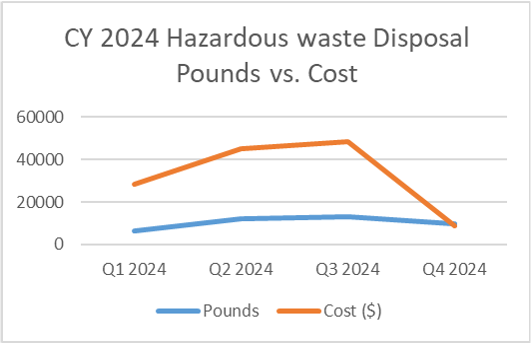
In CY 24, SFSU disposed of 41777 pounds of hazardous wastes at a cost of $130707.02 with invoices from vendors still pending submission and payment.
In Q3, an amended contract with our disposal vendor led to a significant increase in disposal costs
Medical Waste Disposal
Program Description
SFSU generates medical/biohazardous waste from COSE, CLS, Student Health Services, Mashouf Wellness Center and from locked sharps waste disposal boxes around campus.
EH&S’ Environmental Compliance Specialist, arranges for the required weekly disposal of the campus’ medical / biohazardous wastes by a licensed disposal contractor using a properly permitted disposal facility.
CY 2024 Update
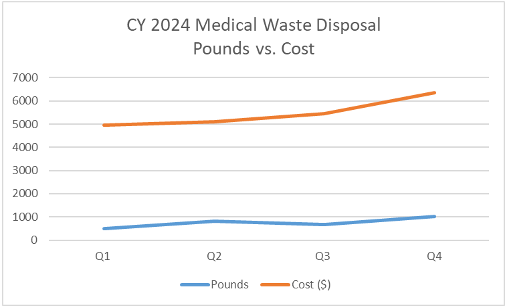
In CY 2024, SFSU disposed of 3006 pounds of medical waste at a cost of $21,853.
Medical Waste Management Plan (MWMP)
Program Description
Under the California Medical Waste Management Act, SFSU is a Large Quantity Generator (LQG) because we generate ≥ 200 pounds of medical waste per month.
As a LQG, SFSU is required to implement procedures for handling, storing, treating, transporting, and disposing of medical waste as described in a Medical Waste Management Plan. The plan is required to be reviewed and updated annually.
CY 2024 Update
The plan was reviewed and updated in CY 2024.
Radioactive Waste Disposal
Program Description
EH&S’ Radiation Safety Officer, arranges for the disposal of SFSU’s radioactive wastes as needed.
SFSU is permitted to store radioactive waste on-site until regulated off-site disposal is available.
CY 2024 Update
EH&S has worked with the faculty to reduce the amount and type of radioactive materials used on campus.
No radioactive waste was disposed of this year. A pick-up is planned for 2025.
Spill Prevention, Control & Countermeasure Plan (SPCC)
Program Description
The SPCC program, is designed to prevent oil spills from reaching navigable waters of the United States or adjoining shorelines.
The program applies to facilities that store, handle, or use oil products above certain thresholds, and requires those facilities to develop and implement a Spill Prevention, Control, and Countermeasure Plan (SPCC Plan).
The SPCC Plan includes a detailed description of the facility’s operations and the measures that will be taken to prevent spills, as well as procedures for spill response and cleanup. The program also includes requirements for regular inspections and testing, recordkeeping and reporting, and training of personnel.
- The CUPA requires SFSU to follow the procedures in our SPCC written program.
- That SPCC program requires us to conduct weekly, monthly, and annual internal inspections to identify leaks, signage, and safe operation of oil containing tanks that are 55 gallons or greater.
- Every five years, the CUPA reviews the SFSU SPCC written plan for accuracy, administrative changes to the plan and completeness.
CY 2024 Update
The 5 year written plan review was completed and signed by a professional engineer.
CUPA reviewed and accepted the updated program.
The next update and review is due in 2029.
Stormwater Pollution Prevention Plan (SWPPP)
Program Description
All of the campus’ stormwater and wastewater flows to the SF sanitary sewer system for treatment before release. Therefore, SFSU is exempt from MS-4 permit requirements, and we do not require a SWPPP.
CY 2024 Update
Not applicable
Total Regulated Waste Disposal
Program Description
EH&S tracks the cost and amount of the total regulated waste, (including universal waste, chemical waste, biological waste, and radioactive waste) generated from a variety of processes.
All waste types have strict regulations concerning their collection, treatment, storage, and disposal.
Regulated wastes are strictly forbidden from being thrown into the regular trash or disposed of down the drain.
CY 2024 Update
In CY 2024 SFSU disposed of is 117,736 pounds of regulated waste at a cost $207, 951 and with invoices from vendors still pending submission and payment.
An amended contract with our disposal vendor led to a significant increase in disposal costs.
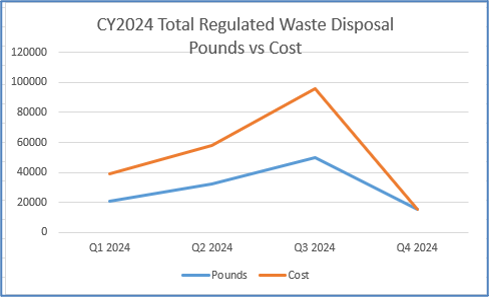
Universal Waste Disposal
Universal waste is a special category of hazardous waste and must not be thrown in the trash. Generally speaking, universal wastes do not pose a hazard when used in their normal manner, but DO pose a hazard if disposed of improperly.
Program Description
Each type of universal waste has its own disposal process. Types of universal waste managed at SFSU include neon, metal halide, sodium, and fluorescent light bulbs, high intensity discharge bulbs, batteries, mercury containing devices, aerosol cans, and electronic waste.
SFSU has designated locations and universal waste labels for collecting each kind of universal waste for recycling.
CY 2024 Update
In CY 2024 SFSU disposed of a total of 73,333 pounds of universal waste at a cost of $55,393. with invoices from vendors still pending submission and payment.
In Q3, an amended contract with our disposal vendor led to a significant increase in disposal costs
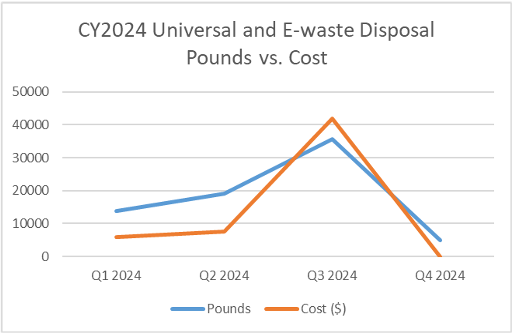
Waste Minimization (SB14)
Program Description
The Hazardous Waste Reduction and Management Review Act of 1989 (SB-14), requires hazardous waste generators to document their waste reduction efforts in compliance with the regulation on a four year cycle.
CY 2024 Update
The plan is due in 2026. No additional action is required at this time.
Wastewater Permits
Compliance with the Federal Clean Water Act is administered in San Francisco by the Bay Area Regional Water Quality Control Board.
Program Description
The program requires that any discharge of wastewaters to surface water needs a permit. The permit sets limits on the quality of the wastewater and requires monitoring.
- All sewage treatment plants have permits.
- Stormwater is also covered by permits.
All wastewater and stormwater from campus drains to the municipal sewer system which goes to a treatment facility that has its own wastewater permit.
CY 2024 Update
Not Applicable.
As of March 9, 2021, the local water quality control board inspector declined to renew the SFSU wastewater discharge permit stating that the campus no longer requires one.
OSHA Injury/Illness Case Incidence Rates
The OSHA Case Incidence Rate is the most widely used standardized tool for measuring injuries.
The CSU requires campuses to report this data for comparison purposes.
The Incidence rate = (Number of injuries and illnesses X 200,000) / Employee hours worked
Graph of SFSU OSHA Case Incidence Rate vs. Year
SFSU OSHA Case Incidence Rate vs. Time Year
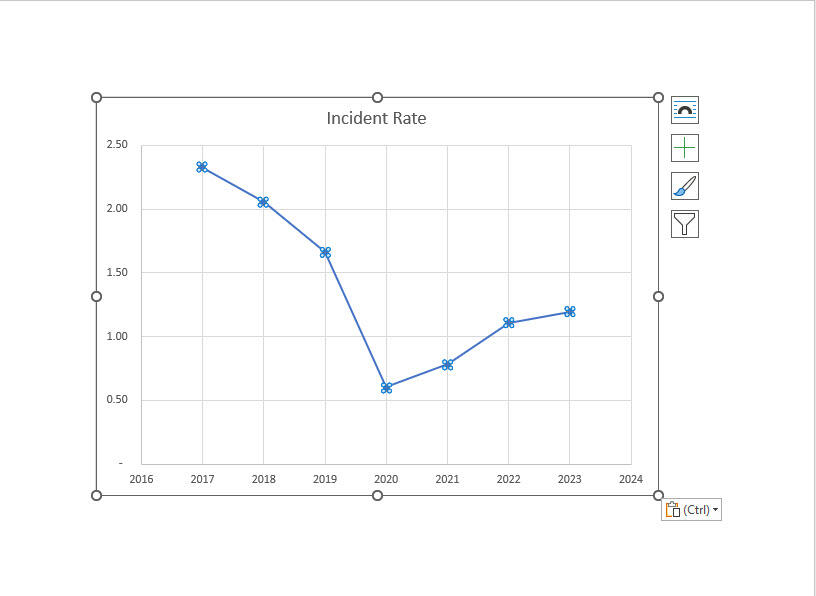
Calendar Year
Graph of OSHA Case Incidence Rate vs. CSU Campus in 2023
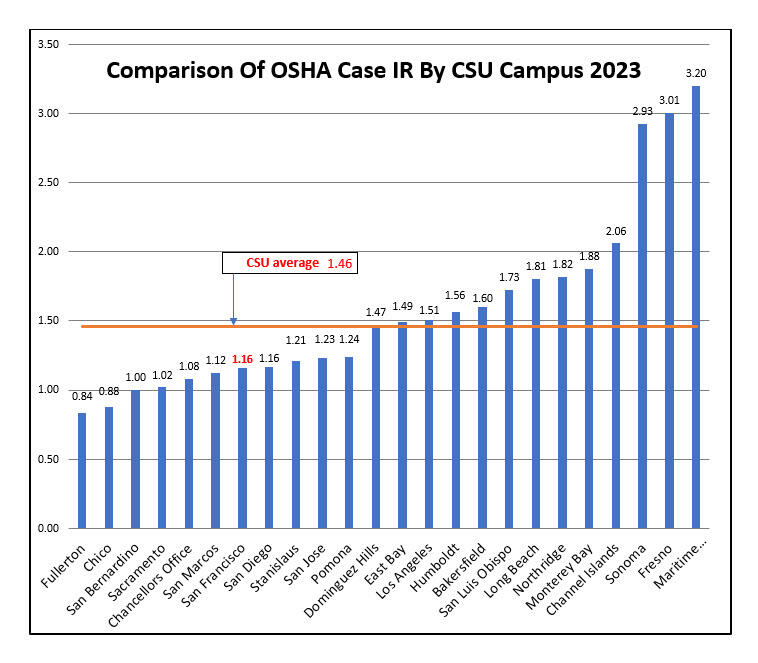
Other EH&S Activities
Annual Campus Safety Week
Annual Campus Safety Week EH&S is a major organizer of the well-received annual campus safety week. This year, in addition to many other activities, EH&S offered 5 days of hands-on fire extinguisher training.
EH&S Website Total Reorganization
EH&S Website Total Reorganization For many reasons, the previous EH&S website was in need of a total reorganization, update, and upgrade to Druple 9. A reboot of the entire website began in January 2023 with the hiring of a student aide/website administrator.
NAGPRA Indian Artifacts Committee
NAGPRA Indian Artifacts Committee EH&S remains a key player in the NAGPRA committee’s work on repatriating native American Indian artifacts.
New Science Engineering Innovation Center (SEIC) Building
New Science Engineering Innovation Center (SEIC) Building EH&S is providing ongoing support for the opening and operation of the new Science Engineering Innovation Center (SEIC) building. EH&S managed chemical movement between COSE buildings, closure of some chemical labs, and assisted with gaining fire marshal approval for the building permit.
Conclusion
The EH&S team is proud of its accomplishments in maintaining regulatory compliance with zero penalties in over 6 years.