
Physics, B.S.
Bachelor of Science, Accelerated Master's
About this program
The Bachelor of Science in Physics gives you deep training in how the physical world works. You’ll study motion, energy, matter and space, and gain hands-on experience with lab tools and scientific methods. This degree is a good fit if you want to pursue research, engineering or graduate study in science. It builds your problem-solving, math and teamwork skills, preparing you for careers in labs, tech, or education.
Program Curriculum and Requirements
Program Scope
The B.S. in Physics requires in-depth technical training, advanced laboratory experiences, and specialized elective topics. Students with often pursue science and engineering careers in colleges & universities, industrial research & development labs, or government labs & agencies, or pursue advanced graduate degrees in physics, astronomy, planetary science, or engineering.
Program Learning Outcomes
Graduates with physics, astronomy, and astrophysics degrees will be able to:
- Describe universal physical principles in classical mechanics, electricity & magnetism, special & general relativity, thermodynamics & statistical mechanics, quantum mechanics, astronomy & astrophysics, and relate fundamental conservation principles (conservation of energy, conservation of linear momentum, conservation of angular momentum) to underlying symmetries of nature.
- Analyze real-world physical systems on Earth and throughout the Universe, develop simplified models of such systems, translate physical principles into the language of mathematics, and then apply the appropriate mathematical tools (vector calculus, linear algebra, differential equations, variational techniques, probability & statistics, numerical & computational methods) to determine a system's spatiotemporal evolution with an awareness of the limitations of any solutions due to the approximations of the physical models and/or mathematical/computational techniques.
- Demonstrate proficiency with basic laboratory skills and experimental techniques with electronics, lasers & optical devices, sensors, detectors, microscopes, and telescopes, always with appropriate safety practices (especially with respect to lasers, chemicals, radioactive materials).
- Articulate and apply the “scientific method,” the empirical, iterative method of acquiring new knowledge through developing models to explain observations of the natural world, formulating testable hypotheses, designing and executing experimental, computational, and theoretical investigations to test predictions, analyzing data with appropriate statistics and attention to uncertainties, ascertaining consistency with existing theories, and sharing results with the broader scientific community for confirmation and validation.
- Demonstrate writing, speaking, and visual data presentation skills to effectively communicate science at the appropriate level of sophistication for the relevant target audience (e.g., instructors, students, scientists, public-at-large, policy-makers).
- Develop the social and communication skills to effectively participate in diverse scientific teams, including those that are multidisciplinary and/or interdisciplinary, and appreciate that the pursuit of science is a human endeavor and that progress is best made when the full spectrum of humanity is encouraged to participate and share their perspectives, passions, and skills.
- Engage local, state, national & global communities to address current and emerging scientific and technological challenges in equitable and environmentally sustainable ways.
SFSU Accelerated Bachelor's + Master's
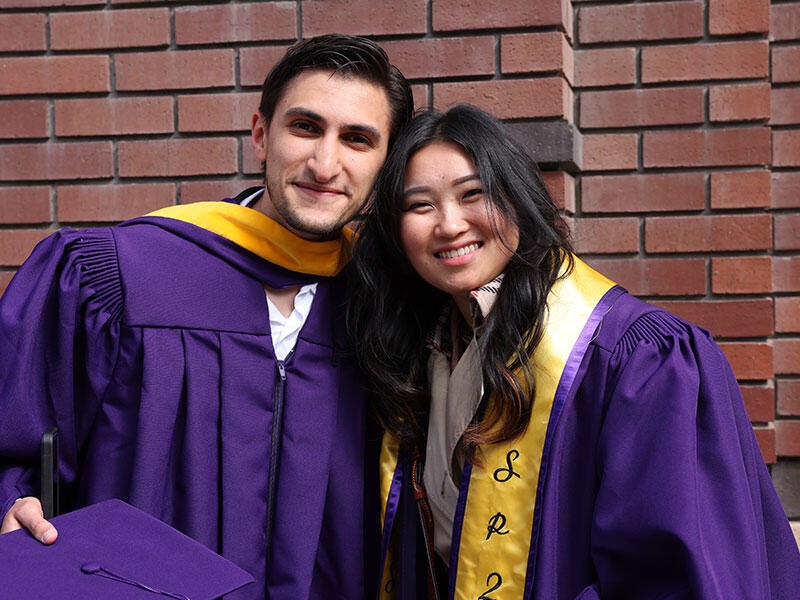
The Department of Physics & Astronomy offers a blended B.S./M.S. program to allow motivated undergraduates accelerated pathways toward graduate degrees in physics and astronomy. These programs are excellent preparation for employment in industry, research laboratories, community colleges, planetaria, observatories, and science museums, as well as admission to competitive Ph.D. programs.